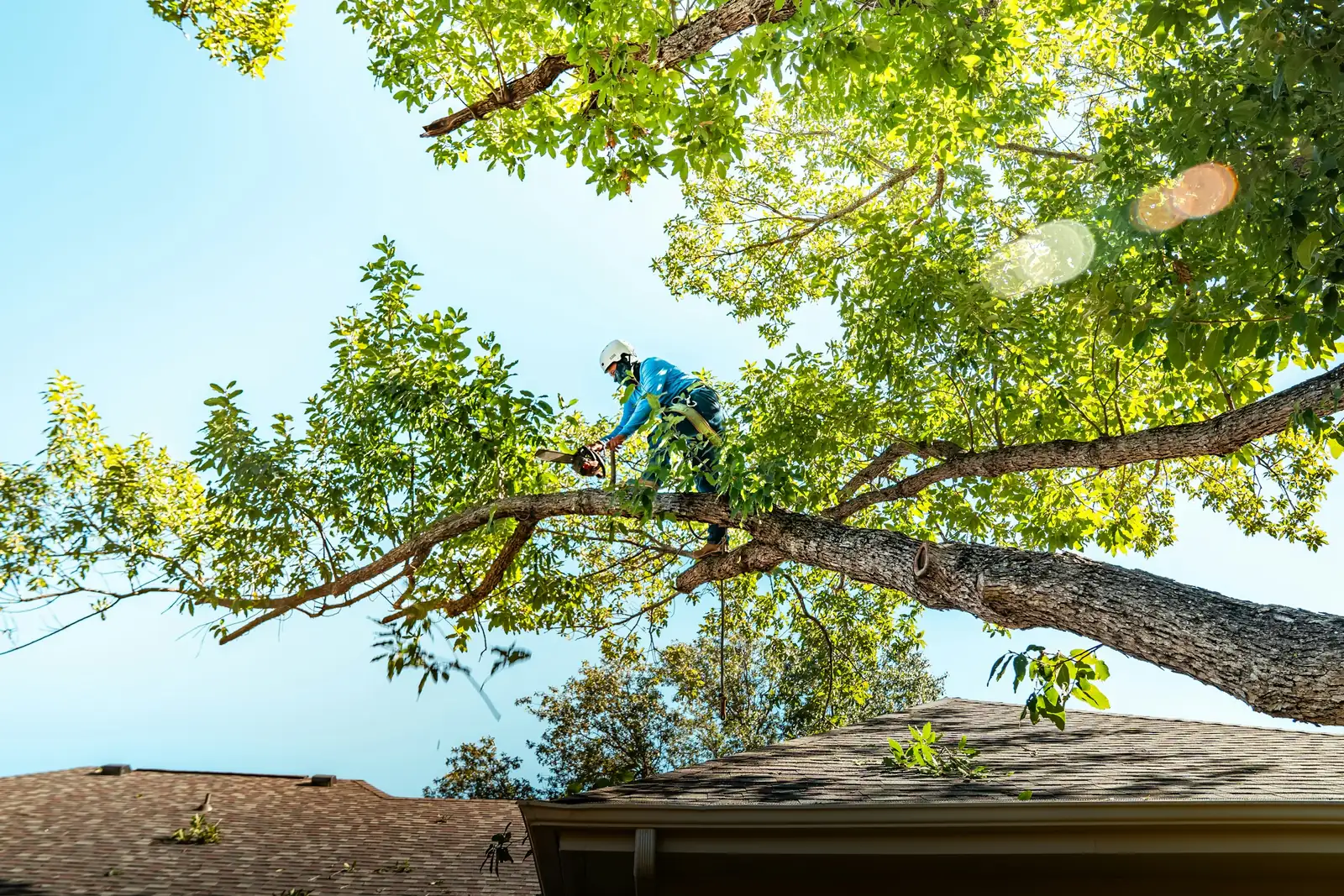
If you need fallen tree removal in Columbus, GA, the hard part has already happened: the tree is down. What is left is cutting it apart without anyone getting hurt, without wrecking what it landed on, and without leaving a mess behind.
Plenty of trees fall on calm, dry days. Root rot, soaked soil, and old root damage take trees down with no storm at all. Foster's Tree Service cuts up and hauls off fallen trees across fences, yards, and driveways, with emergency services 24/7.

What Our Columbus Fallen Tree Removal Includes
- Checking for downed wires and anything still hung up overhead before we start
- Releasing bent limbs and trunk tension in a safe order
- Cutting the tree off fences, sheds, and cars in pieces small enough to lift away
- Cutting the trunk into lengths and loading wood and brush into the truck
- Dealing with the root plate on an uprooted tree
- Raking, blowing off driveways and streets, and hauling everything away
If the stump or root plate needs to go, stump grinding finishes the spot. For a yard with many trees and limbs down after a storm, see storm damage cleanup.
Fallen Tree Situations We Handle
Across a fence
The trunk is resting on rails or posts. Cut in the wrong order, the weight drops harder and takes out more fence.
Blocking a driveway
A trunk across the drive can keep you from getting out or getting in. We can open a lane first, then finish the rest.
Uprooted with roots standing
A wall of roots and soil stands up out of the hole. Once the trunk is cut, that plate can rock back.
Snapped off at the trunk
A jagged break with a trunk on the ground usually points to decay at that spot. We check what is still standing.
Down across a street
The City of Columbus asks residents to report road hazards to its Citizen Services Center at 311. We handle the part on your property.
Down on wires
Stay back. Georgia Power says to treat any downed line as live and life-threatening, and to report it at 1-888-891-0938.
Why Trees Fall on Calm Days
A tree that drops on a still afternoon catches people off guard. In a University of Georgia article, extension agent Stephen Pettis wrote that many trees that topple look perfectly healthy before they fall, and only afterward does it become clear no structural roots were left. He named Inonotus as the most common fungus rotting the base and root collar of water oaks.
Water is the other half. When the soil stays soaked for days, roots lose their grip, and a tree with a heavy crown can tip over in a light breeze. Trees whose roots were cut years ago for a driveway, sewer line, or addition are more likely to go.
After we clear a fallen tree, we look at the root plate or stump and tell you what we see. If a tree of the same kind stands nearby, that is worth knowing now.
How We Remove a Fallen Tree
- Check for wires and hazards. Nothing gets cut until we know no lines are involved and nothing is hung up overhead.
- Read the tension. We find the limbs pinned and bent under the trunk, and we check whether the root plate could tip.
- Clear the crown first. Limbs and brush come off the top so the trunk is easier to see and reach.
- Take the weight off what it hit. Over fences and sheds, the trunk is cut in short pieces and lifted away, not dropped.
- Section the trunk and handle the roots. The trunk is cut into lengths, then cut free from the root plate.
- Load, haul, and clean up. Wood and brush go in the truck, and the yard and pavement are raked and blown off.
Fallen Tree Removal Options Compared
| Option | Best For | What to Expect |
|---|---|---|
| Full cut and haul-off | Most yards, and anyone who wants the tree gone | Wood, brush, and debris leave with the crew, and the ground is raked |
| Cut and stack the wood | Homeowners who burn wood or have a use for it | The trunk is cut to lengths and stacked where you choose, and brush is hauled off |
| Open a path now, finish later | Trees blocking a driveway or gate after dark | A lane is cut open first, and the rest comes out on a scheduled visit |
| Cut, haul, and grind | Uprooted or snapped trees in lawns you want to replant | The stump or root plate is ground below grade after the tree is gone |
If you only need the leftover limbs and brush gone, our tree debris and brush removal service handles the hauling.
What Affects the Cost of Fallen Tree Removal
- Trunk size. Diameter drives how many cuts it takes and how much weight has to be loaded.
- What it landed on. A tree on a fence or shed takes more careful cutting than one lying in open grass.
- Tension and tangle. Trees wedged against other trees or full of bent limbs take more time to release safely.
- The root plate. An uprooted tree with a big root plate adds cutting and grinding work.
- Access. A tree in a fenced backyard with a narrow gate takes longer than one in the front yard by the street.
- Wood and debris. Keeping firewood lengths on site trims the hauling, and taking everything means more truckloads.
- Stump work. Grinding the stump or root plate is optional.
Fallen Trees and Columbus Soil
The fall line, where the Piedmont meets the Coastal Plain, runs right through Columbus. Yards to the north tend to sit on red clay, and yards to the south and east on sandier ground. Clay drains slowly and can stay soggy after heavy rain, while sand drains faster but holds roots less firmly.
With well over 40 inches of rain a year, local soil stays wet for long stretches. After a soggy week, older water oaks and laurel oaks in Midtown, Wynnton, and Lakebottom deserve a look, since both tend to decay inside as they age.
Wind still plays a part. The National Weather Service counted between 100 and 200 trees snapped or uprooted along the path of the April 19, 2009 EF2 tornado that crossed from Phenix City into Columbus.