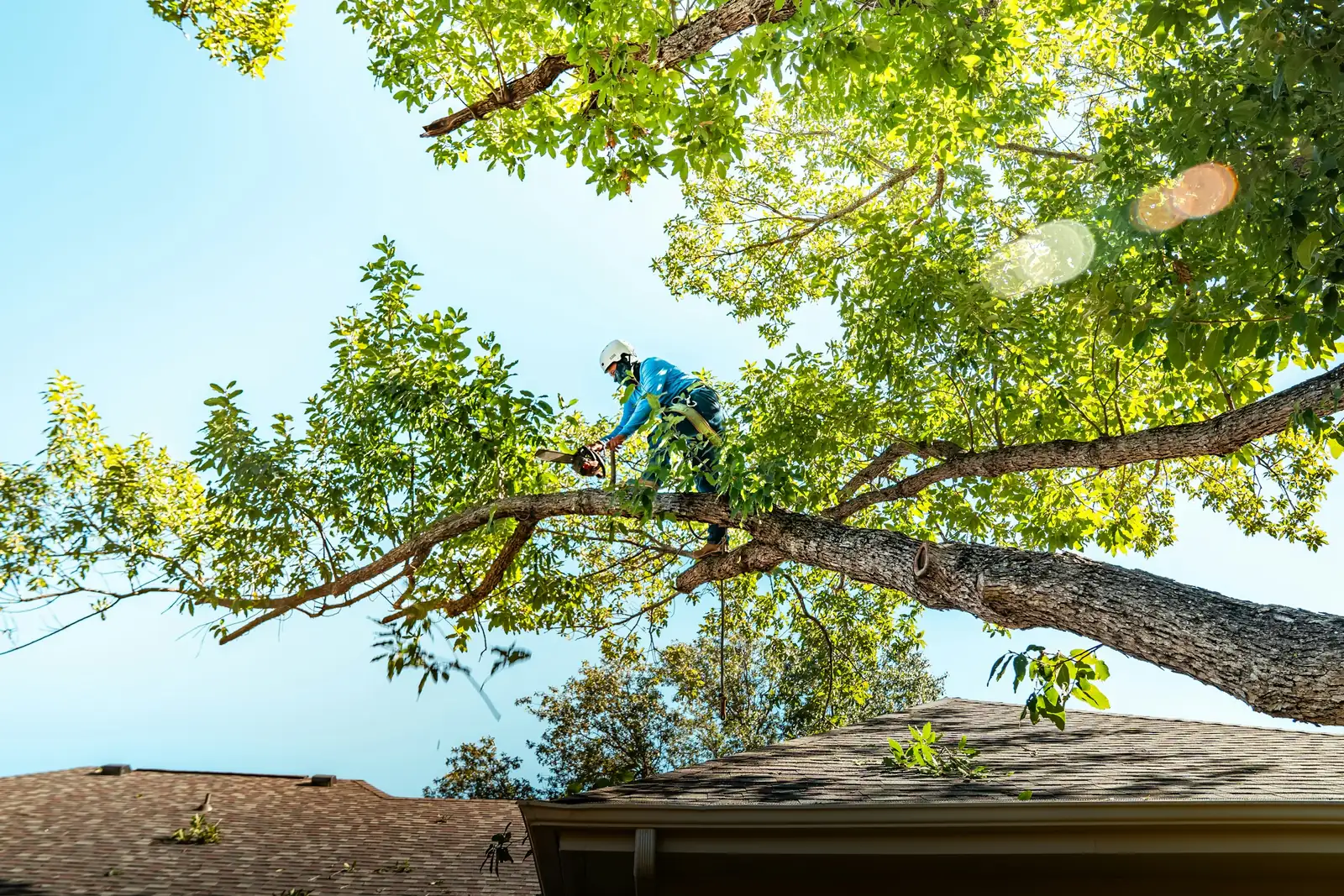
If you need tree trimming in Columbus, GA, the goal is a healthier, safer tree, not a trunk with a few stubs left on it. Foster's Tree Service is a family-owned outfit run by Billy Foster and his son, and we prune the oaks, pecans, pines, magnolias, and crape myrtles that shade yards all over town.
Good pruning is mostly restraint. Every cut is a wound the tree has to close, so each one needs a reason: dead wood, a limb rubbing another limb, clearance over a walkway, or too much weight hanging off one side.
If your main worry is limbs over the house, see overhanging branch and roof clearance. If hurricane season is on your mind, ask about storm-prep pruning.

What Our Columbus Tree Trimming Includes
Most jobs combine a few standard pruning types. We walk the tree with you first and agree on which ones it actually needs.
- Crown cleaning. Removing dead, dying, diseased, and weakly attached branches, often called deadwooding.
- Crown thinning. Selectively lightening the outer crown so wind and light pass through, without stripping out the interior.
- Crown raising. Taking off lower limbs for clearance over lawns, driveways, sidewalks, and sight lines.
- Crown reduction. Shortening height or spread by cutting back to a strong side branch instead of topping.
- Structural pruning for young trees. Choosing one main leader and spacing branches early so the tree needs less correction later.
- Cleanup. Chipping or hauling the brush, raking the beds, and blowing off the driveway.
How much comes off matters as much as where. The International Society of Arboriculture's Pruning Mature Trees guide says that generally no more than 25 percent of the crown should be removed at once, and less for mature trees. Leaves feed the tree, so we would rather come back later than strip a big oak in one visit.
Signs Your Trees Need Trimming
Dead limbs in the canopy
Bare gray branches that stay leafless in summer, or limbs with bark sloughing off, will come down eventually, usually on a windy afternoon.
Branches rubbing together
Two limbs grinding against each other wear through the bark and give decay a way in.
Low limbs in the way
You duck under branches to mow, or the delivery truck scrapes them backing out of the driveway.
A lopsided, heavy crown
Long limbs reaching for sun on one side put extra leverage on the trunk and the branch unions.
Sprouts from old topping cuts
Clusters of fast, upright shoots growing from old stubs need to be thinned and retrained over a few visits.
Cracks in the trunk, cavities, or mushrooms at the base are a different story. Those can mean decay, and our dead and hazardous tree removal page explains what they may point to.
Our Tree Trimming Process
- Walk the yard together. We look at each tree from the ground, hear what bothers you, and point out things like dead wood high in the crown.
- Agree on a plan. You hear which limbs come out and why, so nothing surprises you when the crew shows up.
- Set up safely. Trucks get positioned with cones on the street when needed, and limbs over roofs, fences, and beds are lowered by rope instead of dropped.
- Prune with proper cuts. Each cut is made just outside the branch collar, the slight swelling where a limb joins the trunk. Flush cuts and stubs both invite decay.
- Clean up. Brush is chipped or hauled, debris is raked, and the driveway and street are blown off.
Timing matters too. UGA Extension's Basic Principles of Pruning Woody Plants calls the dormant winter season, before new growth begins in spring, the best time for pruning, and it advises against heavy pruning in late summer and fall. Dead or broken limbs are the exception and can come out any time.
Pruning Methods Compared
The tree care industry's pruning standard in the U.S. is ANSI A300, and ISA consumer guidance is blunt about one practice in particular. According to the ISA's Why Topping Hurts Trees, topping can remove 50 to 100 percent of a tree's leaf-bearing crown, and the shoots that sprout back can grow as much as 20 feet in one year in some species while being only weakly attached.
| Method | Best For | What to Expect |
|---|---|---|
| Crown cleaning | Mature trees with dead, broken, or crossing limbs | Light stress on the tree and fine any time of year |
| Crown raising | Clearance over driveways, walks, and lawns | Lower limbs removed gradually so the trunk keeps its taper |
| Crown reduction | Trees that have outgrown their space | Cuts back to side branches at least one-third the diameter of the removed limb, keeping a natural shape |
| Topping | Nothing. We do not do it. | Stubs, weak regrowth, decay, and a bigger problem a few years later |
What Affects the Cost of Tree Trimming
- Tree size. A mature water oak takes more climbing time and more cuts than a crape myrtle by the patio.
- Amount of pruning. A light deadwooding goes faster than cleaning, raising, and reducing the same tree.
- Access. Backyard trees behind fences, pools, or narrow side yards mean more rope work and more hand-carrying of brush.
- What sits underneath. Limbs over roofs, screened porches, or service lines have to be lowered carefully, which takes time and rigging.
- Number of trees. Pruning several trees in one visit is usually more efficient than scheduling them one at a time.
- Debris handling. Hauling everything off takes more time than leaving firewood rounds or chips you want to keep.
Trimming Trees in Columbus Neighborhoods
Columbus has a lot of big trees growing close to houses. In Wynnton, Midtown, Lakebottom, and Dinglewood, mature water oaks, willow oaks, live oaks, and pecans spread over roofs and narrow lots, often with service lines running through the canopy. Those trees do best with regular, light cleaning rather than one heavy cut after years of neglect.
Water oaks and laurel oaks tend to decay inside as they age, so old wounds get a close look while the climber is up there. Tall loblolly pines in newer north Columbus subdivisions mostly need dead limbs and broken stubs cleared, not shaping.
Crape myrtles do not need to be cut back to knobs each winter. UGA Extension treats them as summer bloomers to prune in late winter or early spring, and notes they can be kept in tree form by selective thinning.