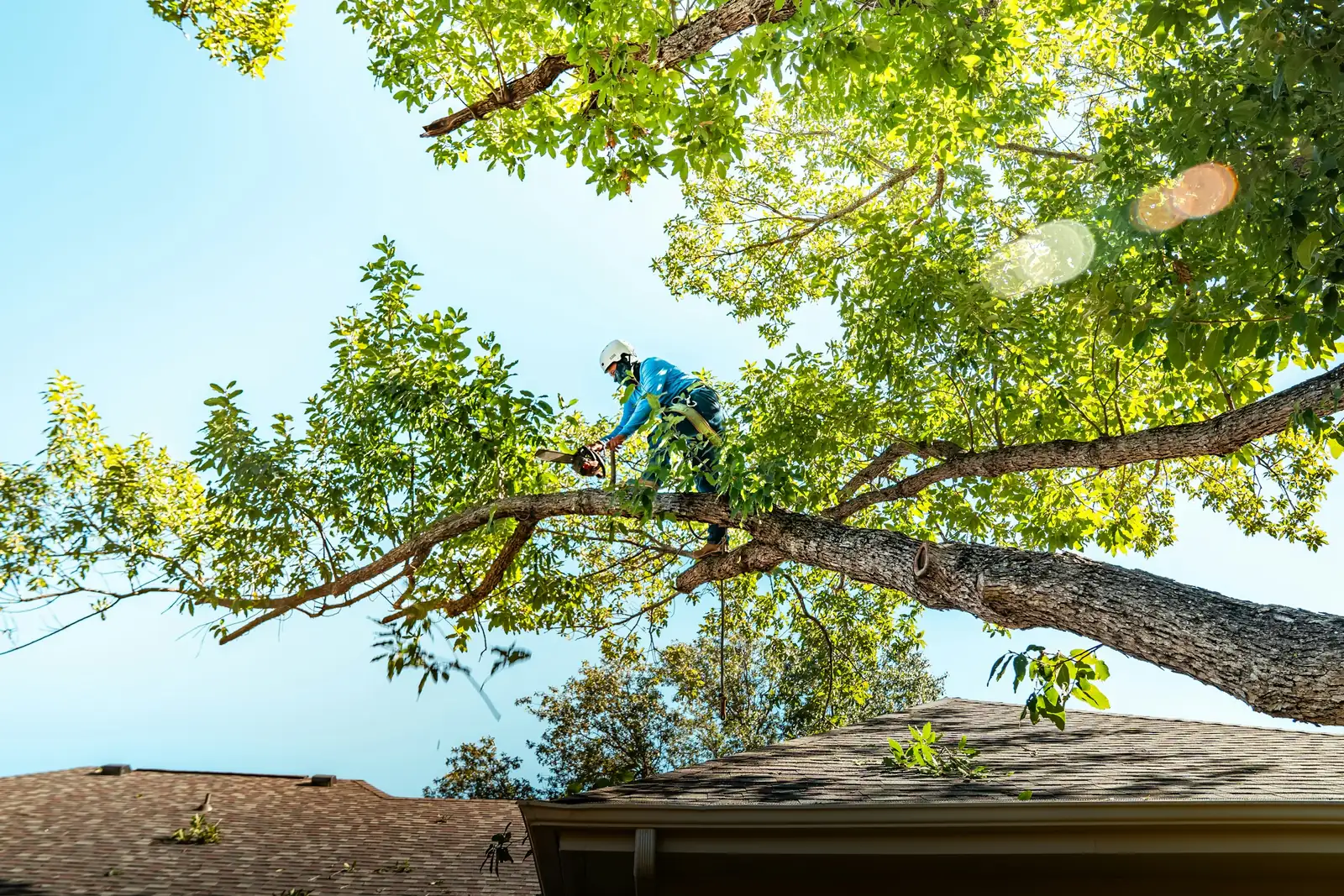
If you need tree removal in Columbus, GA, you probably already know which tree it is. Maybe it is the water oak that drops limbs on the driveway, or the pine that grew too close to the bedroom.
Foster's Tree Service is family-owned, run by Billy Foster and his son out of north Columbus. This page covers planned removals: trees that come down on your schedule, not mid-storm.
If a tree is already on the house or across the driveway, go to our emergency tree removal page. We offer emergency services 24/7.

What Our Columbus Tree Removal Includes
Every removal starts with a look at the tree and everything around it. A standard job covers:
- A walk-around to talk through the drop zone and where the trucks can park
- Felling the tree whole when there is room, or taking it down in sections
- Cutting the trunk and limbs into pieces the crew can load
- Chipping brush and hauling the wood, or leaving firewood rounds if you ask
- Raking, blowing off the driveway and street, and a final walk-through
- Stump grinding below grade, if you add it
Cleanup is the part people mention. Brent Parker's review describes the crew loading his oak into the dump truck, raking up, and blowing off the street.
When It Makes Sense to Take a Tree Down
The tree is declining
A thinning crown or dead limbs up high. If it is already dead or rotting, see dead and hazardous tree removal for the warning signs.
It is in the way of a project
An addition, pool, or new driveway can run right through a root zone. Removing the tree first beats nursing it through root damage.
Wrong tree, wrong spot
A pine a few feet from the house, or a sweetgum dropping spiky balls on the patio. Some trees outgrew where someone planted them.
Roots are lifting things
Cracked driveways and heaved sidewalks usually get worse as the tree grows.
You want the sun back
Grass that will not grow, a garden that never ripens, or a roof that stays damp under dense shade.
How a Planned Tree Removal Works
- Look at the tree together. We walk the tree with you, check what sits under it, and ask whether you want the wood, the stump, or neither.
- Choose the method. Open ground usually means felling. A house, fence, pool, or service line nearby means a sectional takedown.
- Schedule and call ahead. Brent Parker wrote that our crew called him 30 minutes ahead of the scheduled time.
- Set up the site. Trucks get positioned, cones go out on the street, and people and pets stay clear.
- Bring it down. The tree is felled or dismantled piece by piece, then cut up for chipping and hauling.
- Clean up and walk it with you. Raking, blowing, a last look around, and stump grinding if it was in the plan.
Felling vs. Sectional Removal
The biggest call in any removal is whether the tree comes down in one piece or many, and it mostly depends on open space. OSHA's logging guidance says workers generally must stay at least two tree lengths away from a tree being felled until the feller says it is safe. Few Columbus yards have that much room in any direction, so many home removals happen in sections.
| Method | Best For | What to Expect |
|---|---|---|
| Felling whole | Open yards, wooded lots, and trees with a clear landing spot | A notch and back cut aim the tree into open ground. Quickest, but it needs the most room. |
| Sectional dismantling | Trees next to houses, fences, pools, or lines | A climber takes off limbs, then the trunk in pieces. Slower, with far more control. |
| Partial dismantle, then fell | Limbs over something, open ground on one side | Limbs over the target come off first, then the bare trunk is felled into the open. |
For trees squeezed between houses or over a pool, see tree removal near houses and tight spaces.
What Affects the Cost of Tree Removal
- Size. A taller tree with a thicker trunk means more cuts and more wood to haul.
- Method. A sectional takedown takes more labor than felling into open ground.
- What sits underneath. Roofs, fences, and service lines slow the work because every piece has to be controlled.
- Access. A tree the trucks can reach from the driveway goes faster than one behind a narrow gate.
- Condition. Dead or decayed wood does not hold rigging the way sound wood does.
- Cleanup choices. Hauling everything, leaving firewood, and adding stump grinding each change the scope.
Customers have called our pricing reasonable and fair, and Foster's holds a 4.8-star Google rating from 67 reviews. The only way to know your number is to have the tree looked at.
Do You Need a Permit to Remove a Tree in Columbus?
Straight answer: we have not found a Columbus rule that requires a permit to remove an ordinary tree from a private home lot. We cannot promise no rule touches your tree, though, so check before the work date. Columbus and Muscogee County share one consolidated government, so the city is the place to ask.
- Street trees belong to the city. Right-of-way trees are managed by the city's Urban Forestry and Right-of-Way Division. Call 311 before touching one.
- Building projects have their own rules. The city's tree preservation standards in the Unified Development Ordinance are tied mainly to development. If construction is involved, ask the Planning Department.
- Historic districts get reviewed. The Board of Historic and Architectural Review must approve exterior changes to designated historic properties. Its page does not mention trees, so ask staff first.
- HOAs write their own rules. Some subdivisions require committee approval before a tree comes down. Check your covenants and get approval in writing.
Tree Removal Around Columbus Neighborhoods
A removal looks different depending on where you are in town. From the Historic District out through Wynnton, the typical job is a mature oak or pecan that has run out of room beside an older house, so it comes down in sections. On bigger, more wooded lots toward Midland and Upatoi, there is more often room to fell a tree whole. In the newer subdivisions of north Columbus, the tree in question is usually a tall loblolly pine.
The ground changes too. Columbus sits on the fall line, with red Piedmont clay to the north and sandier Coastal Plain soil to the south and east. After a wet week, slick clay limits where a loaded truck can go, so we plan the route before the first cut.