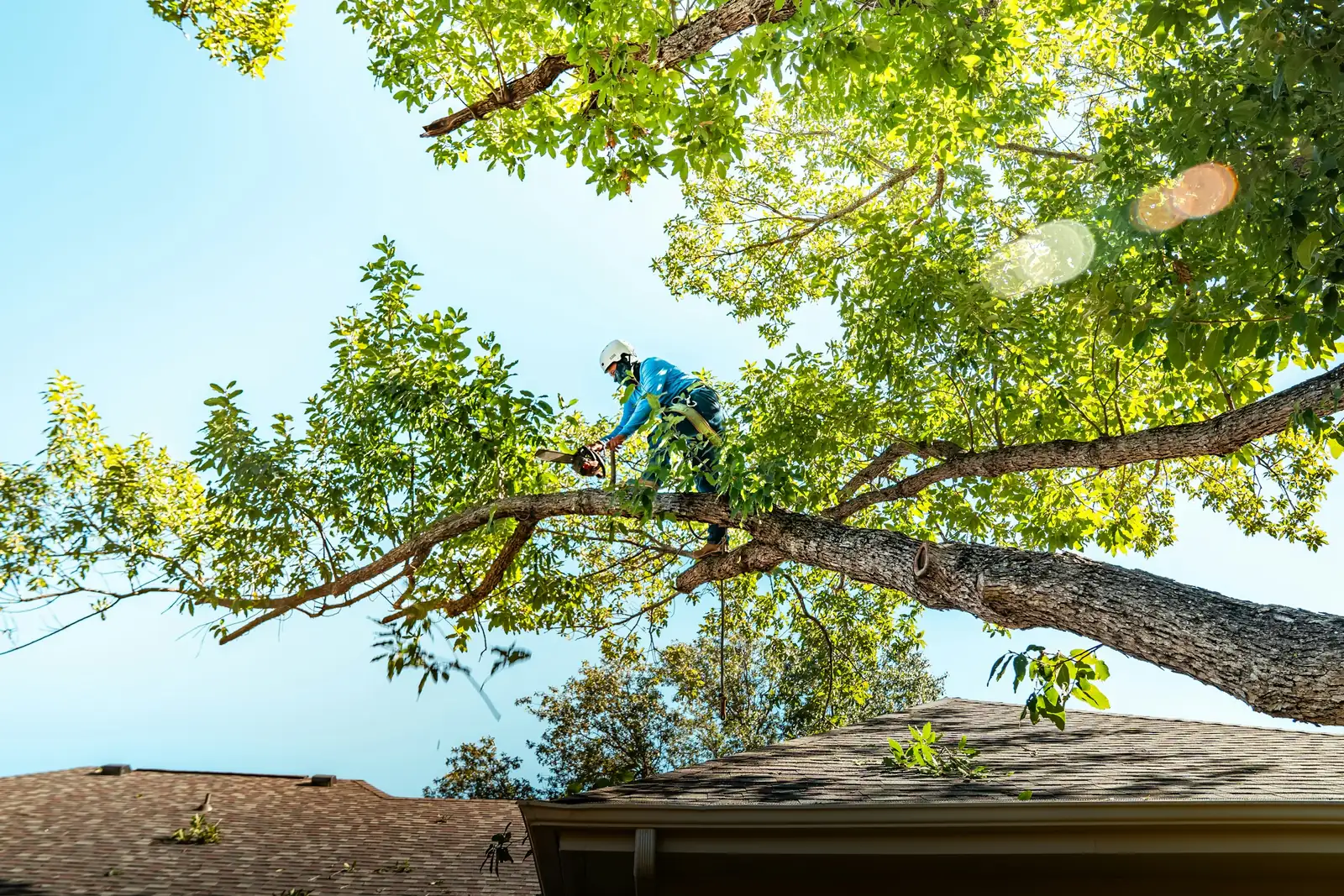
If you want storm-prep tree pruning in Columbus, GA, the time to call is on a calm, sunny day, long before the first storm watch goes up. The limb that breaks in a storm was usually dead, cracked, or overloaded well before the wind found it.
Foster's Tree Service prunes the limbs most likely to fail over your house, driveway, and fence. We take out dead wood, cracked limbs, and weak forks, and we lighten heavy ends without stripping the tree. The goal is a tree that lets wind pass through instead of catching it.
No pruning makes a tree stormproof. What it does is take the most likely failures out of the tree on your schedule, with the crew working on a dry, calm day instead of in the mess after a storm.

What Our Columbus Storm-Prep Pruning Includes
- Removing dead limbs, especially over the roof, driveway, and play areas
- Cutting out cracked limbs and broken stubs left from past storms
- Shortening long, heavy limbs that reach out over the house
- Thinning crowded and crossing branches without stripping the interior
- Pointing out weak forks that may need cabling and bracing or removal
- Chipping and hauling all the brush when we finish
Cuts are made at the branch collar, where a limb flares out at its base, and never flush with the trunk, so the tree can close the wound. For pruning goals beyond storm season, see our tree trimming and pruning page.
Trees That Need Pruning Before Storm Season
Dead limbs over the roof
Bare gray limbs with no summer leaves or with bark falling off. Dead wood is brittle and is often the first thing to come down.
Cracks and old storm damage
Split forks, broken stubs, and hanging limbs left from the last storm are weak points waiting for the next one.
Long limbs over the house
A heavy limb reaching far over the shingles acts like a lever in the wind, with all the strain landing where it joins the trunk.
A Bradford pear in the yard
Clemson Extension notes severe branch splitting in older Bradford pears, and says their narrow branch angles can split trees in half in ice and storms.
Tight V-shaped forks
Two trunks or big limbs growing up tight against each other, often with bark pinched in the crotch, can tear apart under load.
A tall pine standing alone
A UF/IFAS Extension review of storms found trees growing in groups blew down less often than trees growing alone.
How We Prep Your Trees for Storm Season
- Walk the yard with you. We look at every tree that could reach the house, garage, driveway, or fence if it failed.
- Rank the risks. Dead wood and cracked limbs over the roof come first. Shaping work can wait.
- Agree on the cuts. You know which limbs are coming off and why before anyone climbs.
- Prune and lower by rope. Limbs over the roof are cut and lowered on a line, not dropped onto shingles.
- Clean up. Brush is chipped, and the yard and driveway are raked and blown off.
- Flag what pruning cannot fix. If a tree needs cabling or removal instead, you hear it before storm season, not after.
Storm-Prep Pruning Options Compared
| Approach | Best For | What to Expect |
|---|---|---|
| Deadwood and hazard pruning | Mature oaks and pecans over the house | Dead, cracked, and broken limbs come out, and the crown keeps its natural shape |
| Reducing long limbs | Heavy limbs reaching far over the roof | Limbs are cut back to strong side branches, which shortens the lever |
| Structural pruning | Young shade trees still developing their form | Competing leaders are removed so one main trunk takes over as the tree grows |
| Topping or lion's tailing | Nothing. We do not do it. | Both leave a tree more likely to break in the next storm |
The same UF/IFAS Extension article lists over-thinning, removing interior branches, topping, and lion's tailing as practices to avoid. Good storm-prep pruning removes the weak wood and leaves the rest of the tree alone.
What Affects the Cost of Storm-Prep Pruning
- Number of trees. Doing several trees in one visit is more efficient than calling us back for each one.
- Height and spread. A wide water oak over a two-story house takes more climbing than a small maple by the mailbox.
- Amount of dead wood. A tree that has gone years without pruning has more to remove.
- What sits below. Roofs, pools, and the service wire to the house mean more rope work.
- Access. Room for the chipper close to the trees speeds up cleanup.
- Added work. Cabling a weak fork or removing a pear adds to the visit.
- Brush volume. More limbs coming down means more chipping and more loads to haul.
Storm Season in Columbus
By the time Gulf hurricanes reach the Chattahoochee Valley they are usually remnants, and those remnants still carry enough wind and rain to break limbs across Columbus. NOAA sets the Atlantic hurricane season from June 1 through November 30. Spring storms come first: in April 2025, the National Weather Service confirmed an EF1 tornado in Muscogee County with peak winds near 90 mph.
Georgia Power called Hurricane Helene in September 2024 the most destructive hurricane in its history. In an October 2024 update, the utility reported restoring power to more than 1.2 million customers.
Our local trees shape the risk. Water and laurel oaks in Midtown and Wynnton get weaker inside with age, Bradford pears line plenty of front yards, and tall loblollies stand alone in newer North Columbus subdivisions.