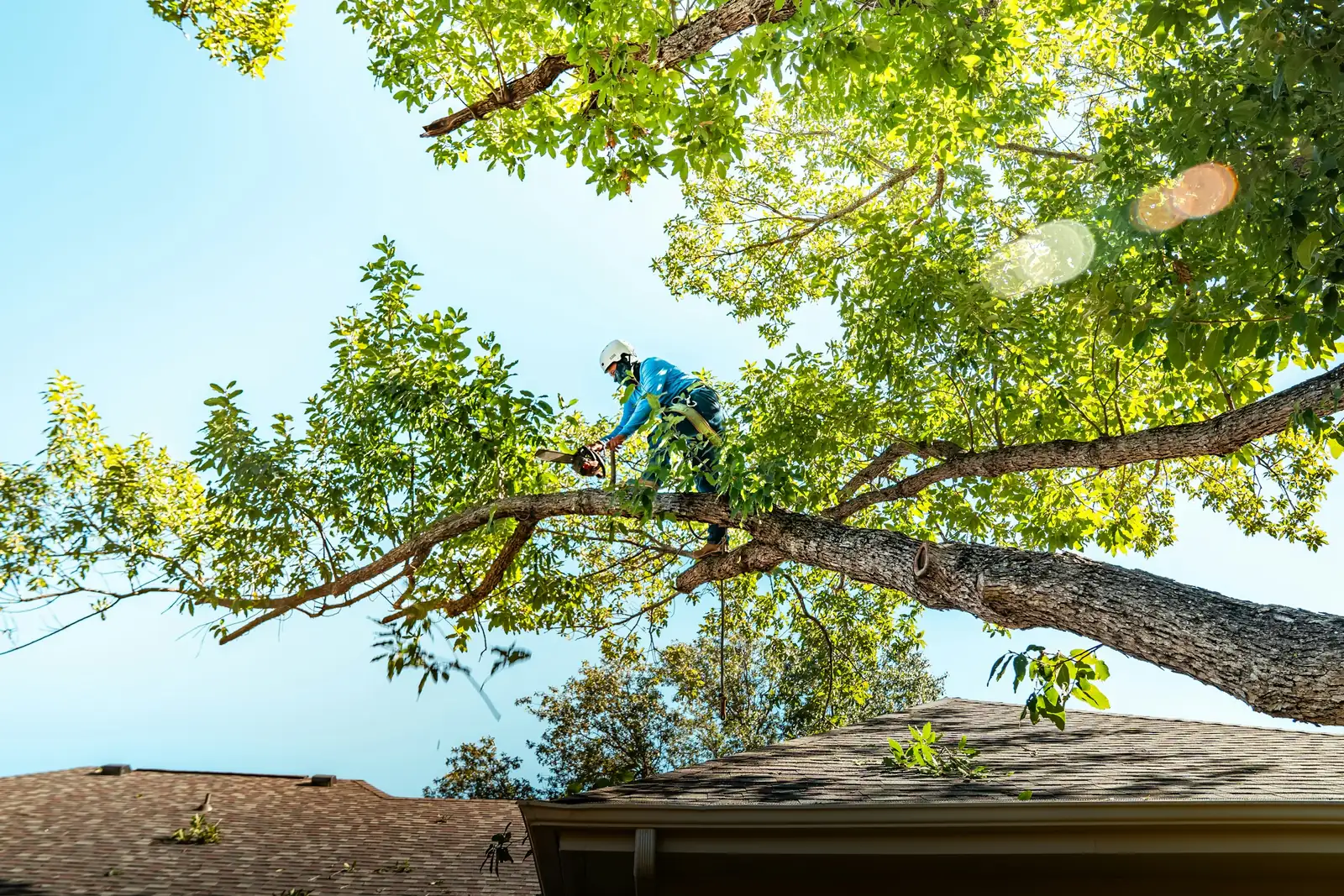
If you need tree removal near houses in Columbus, GA, the hard part is not cutting the tree. It is getting the tree out of a space where nothing can fall: between two houses, over a pool, above a fence, or in a backyard the trucks cannot reach.
These jobs come down to climbing, rigging, and patience. The tree is taken apart from the top down, and pieces that cannot fall free are lowered on ropes to a spot where they can land.
If a tree has already hit the house, our tree on house removal page covers what to do first.

What Our Columbus Tree Removal Near Houses Includes
- A walk-around to map every target: roof, gutters, windows, fence, pool, AC unit, and lines
- A climber working the tree from the top down
- Rigging and rope lowering for limbs and trunk sections that cannot drop
- A planned path from the tree to the street for every piece
- Care for turf, pavers, and pool decks along that path
- Chipping and hauling from the curb, then raking and blowing off
Most of the time on these jobs goes into rigging and moving wood. The cutting is the quick part.
Situations That Call for a Tight-Space Removal
Between two houses
Side yards on older Columbus lots can leave only a few feet between a trunk and two walls.
Over a pool or patio
Concrete coping, screen enclosures, and pool water do not forgive a dropped log.
Along a fence line
Trees grown into or right against a fence, often with the neighbor's yard on the other side.
Backyard with no gate access
Fenced yards where no truck can reach the tree, so everything goes out by hand.
Limbs over the roof
Heavy leaders over shingles, gutters, or a chimney. If you only need the limbs gone, see overhanging branch trimming.
Wires in the canopy
Service, cable, and phone lines running through the branches. Read about tree trimming near power lines before anyone climbs.
How We Remove a Tree in a Tight Space
- Map the targets and the path. We note what needs protecting and how each piece will travel from the tree to the street.
- Climb and set the rigging. A climber ties in high, and lowering lines are set so pieces can be controlled from the ground.
- Take it apart from the top. Limbs come off first, then the top, then the trunk in sections sized for the space below.
- Lower, do not drop. Anything that could hit the roof, fence, or pool is lowered by rope to a clear landing spot.
- Carry it out. Brush and wood move to the chipper and truck at the curb, by hand when there is no other way.
- Clean up and look it over. Raking, blowing off hard surfaces, and a walk around the house with you.
Tight-Space Removal Methods Compared
| Method | Best For | What to Expect |
|---|---|---|
| Free-drop pieces | Small sections with open ground directly below | Quickest. Used only where nothing below can be hit. |
| Rope lowering | Limbs and trunk sections over roofs, fences, pools, and gardens | Each piece is tied off and lowered under control. More labor, far less risk. |
| Hand carry-out | Backyards with no gate or truck access | Wood cut small enough to carry or roll to the street. Slower, but no truck tires on the lawn. |
Most tight-space jobs mix all three. Small limbs over open lawn drop free, anything over the house or pool gets lowered, and the wood leaves through the gate in pieces the crew can carry.
What Affects the Cost of a Tight-Space Removal
- Amount of rigging. The more pieces that must be lowered instead of dropped, the longer the job runs.
- Distance to the truck. Every piece carried through a gate and down a side yard adds labor.
- What sits underneath. Pools, screen enclosures, and older roofs leave less margin than open lawn.
- Lines in the tree. Service lines through the canopy have to be planned around before work starts.
- Trunk size. A thick trunk means more sections to rig and heavier pieces to move to the curb.
- Stump work. Stump grinding beside a foundation or patio takes extra care.
Customers on Google, where Foster's holds a 4.8-star rating from 67 reviews, describe our pricing with words like reasonable and fair. A tight-space job takes more labor than an open-yard removal, so ask for an estimate that spells out how much rigging and carrying your tree will need.
Tight Lots and Big Trees in Columbus
Older in-town lots around Midtown and Dinglewood are narrow, and the oaks and pecans on them never stopped growing. A trunk can sit a few feet from a porch, with the neighbor's driveway on the other side and a service line through the crown. The truck usually stays on the street, and Brent Parker wrote that our crew set orange cones around the trucks before starting.
Roots matter as much as limbs. UGA Extension notes that most tree roots in Georgia clay soils grow in the top 12 to 18 inches, so rolling heavy loads across a yard can hurt the trees you are keeping. That is one more reason we lower, carry, and plan the path instead of driving over the root zone.