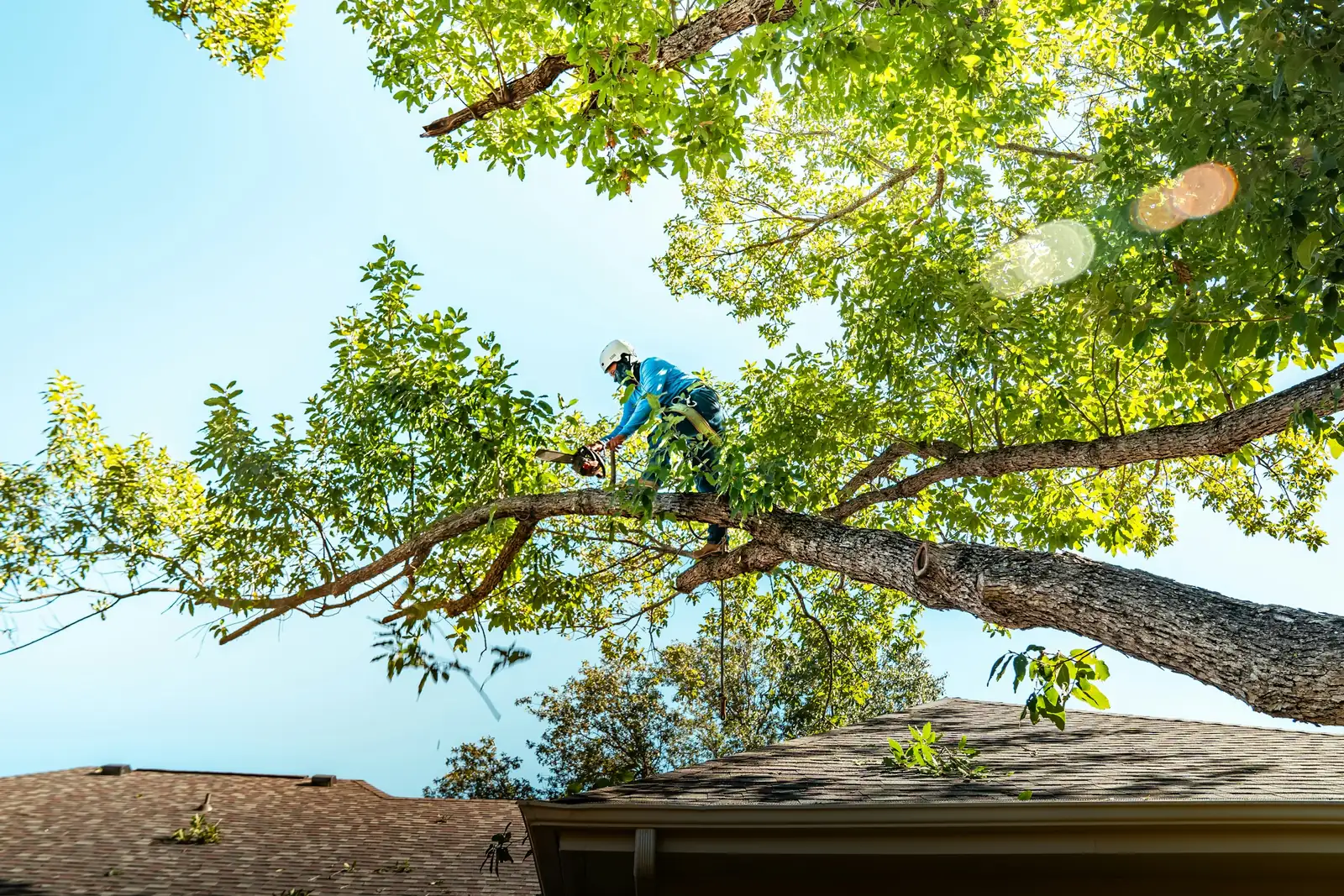
If you need lightning-struck tree removal in Columbus, GA, start by looking at the tree from a safe distance once the storm has passed. A strike can split a trunk wide open, or leave one strip of missing bark that looks minor and still kills the tree over the next few months.
Foster's Tree Service checks struck trees, tells you plainly which ones should make it, and removes the ones that will not. We offer emergency services 24/7 for trunks that split or pieces left hanging over the house.

What Our Columbus Lightning-Struck Tree Removal Includes
A struck tree gets a full look before any saw comes out. Split and shattered wood does not behave like sound wood when it is cut.
- Checking the trunk, crown, and base for splits, loose bark, and lifted soil
- Taking down split sections or hanging pieces over the house first
- Removing the tree in rope-lowered sections near roofs, fences, and driveways
- Looking over nearby trees, since one strike can damage more than one
- Hauling off struck pine wood instead of leaving it in the yard
- Stump grinding if you want the spot ready for something new
Signs Lightning Hit Your Tree
A long strip of missing bark
A seam of bark blown off, often from high in the crown to the ground. On pines it may spiral around the trunk.
A split or shattered trunk
A crack you can see daylight through, or a trunk opened up like a peeled banana. A shattered trunk can kill a tree outright.
Bark and splinters in the yard
Chunks of bark or long slivers of wood on the lawn, roof, or driveway, sometimes a good distance from the tree.
Scorched or blackened wood
Dark, burned-looking wood along the edges of the wound, sometimes with fresh sap bleeding from the seam.
Lifted soil at the base
Loose dirt, torn turf, or exposed roots around the trunk can mean the charge traveled through the root zone.
Needles fading weeks later
Needles turning pale green, then yellow, red, and brown is how the Georgia Forestry Commission describes southern pine beetle attack.
Why Struck Pines Often Die Later
Lightning can heat the air it passes through to 50,000 degrees Fahrenheit, according to the National Weather Service. When it hits a tree, that heat vaporizes the water in its path, which can blow off a strip of bark or make the trunk explode.
The visible wound is only part of it. In a piece for the University of Georgia, Kim Coder wrote that a strike can blow root pieces out of the ground and that a struck tree invites pests, like southern pine beetles in pines.
The Georgia Forestry Commission says lightning-struck trees are particularly vulnerable to southern pine beetle attack, and it calls that beetle the most destructive forest insect in the southeastern United States. A struck loblolly can stay green for weeks, so a healthy-looking crown is not a clean bill of health.
Hardwoods are different. Clemson Cooperative Extension notes that oaks may show branch damage on only one side, while pines die back in a spiral. A struck oak with a narrow wound is often worth watching.
How We Handle a Struck Tree
- Wait out the storm. Nobody climbs or works under a tree while thunder is still around.
- Make the immediate danger safe. Split sections, hanging pieces, and limbs over the roof come down first.
- Inspect the whole tree. We trace the wound from crown to roots and check the trees standing nearby.
- Give you a straight answer. Remove it now, remove the damaged parts, or watch it. We explain the reason either way.
- Take it down in pieces near structures. Close to the house, the tree is cut in sections and lowered by rope.
- Haul off the wood and clean up. Struck pine leaves the property, and the yard is raked and blown off.
Options for a Lightning-Struck Tree
| Option | Best For | What to Expect |
|---|---|---|
| Remove the whole tree now | Struck pines, split trunks, and trees leaning toward the house | The tree comes down in sections and the pine wood is hauled off |
| Remove the damaged parts | Hardwoods with damage on one side and a sound trunk | Dead or split limbs come out and the tree gets a second look later |
| Watch through the next growing season | Oaks and other hardwoods with a narrow wound and no split | You watch for thin leaves, new cracks, or dieback and call us if they appear |
If a struck pine is one of several near your house, see our pine tree removal page. Not sure the tree was hit at all? A tree health and hazard inspection gives you an honest read first.
What Affects the Cost of Lightning-Struck Tree Removal
- How badly the trunk is split. Shattered wood can break in odd directions, so it takes more rigging and slower cuts.
- Height and trunk size. A tall loblolly takes longer to dismantle in pieces than a medium oak.
- What is nearby. Roofs, fences, and the service line to the house mean lowering by rope instead of felling.
- How many trees were hit. A strike can damage a cluster of trees, and each one needs checking.
- Wood disposal. Struck pine is usually hauled away rather than left in the yard.
- Stump grinding. Optional, and based on the size of the stump.
- Timing. A split tree hanging over the house at night is a different job from a scheduled removal.
Lightning and Tall Trees in Columbus
Clemson Cooperative Extension lists pines and oaks among the trees lightning strikes most often, and it names the tallest trees in a group, solitary trees, and trees near water as likely targets. That describes a lot of Columbus.
Newer subdivisions in North Columbus often have tall loblolly pines left standing on their own during development, with nothing taller nearby. In Wynnton, Dinglewood, and Peacock Woods, big oaks and pecans tower over older homes. Along the Chattahoochee, in places like Bibb City and Green Island Hills, big trees grow close to the water.
The city straddles the fall line, so a North Columbus yard may sit in red clay while one to the south or east sits in sandier Coastal Plain soil. In either one, a strike that blows roots loose leaves the tree with less to hold onto when the next windstorm comes through.